The Six Levers of Total Rewards – And Why Small Business Should Use All of Them
Most business owners think about compensation and benefits in two buckets: what people are paid and what benefits the business can afford to offer. A natural place to start. There is significantly more available to owners who want to think strategically about attraction, retention, and business value.
The WorldatWork Total Rewards Framework is the practitioner standard used across the compensation field. It identifies six levers, and when all six are managed with intention, the result is a people strategy that is more effective, more sustainable, and more visible to anyone evaluating the health of the business.
The Six Levers
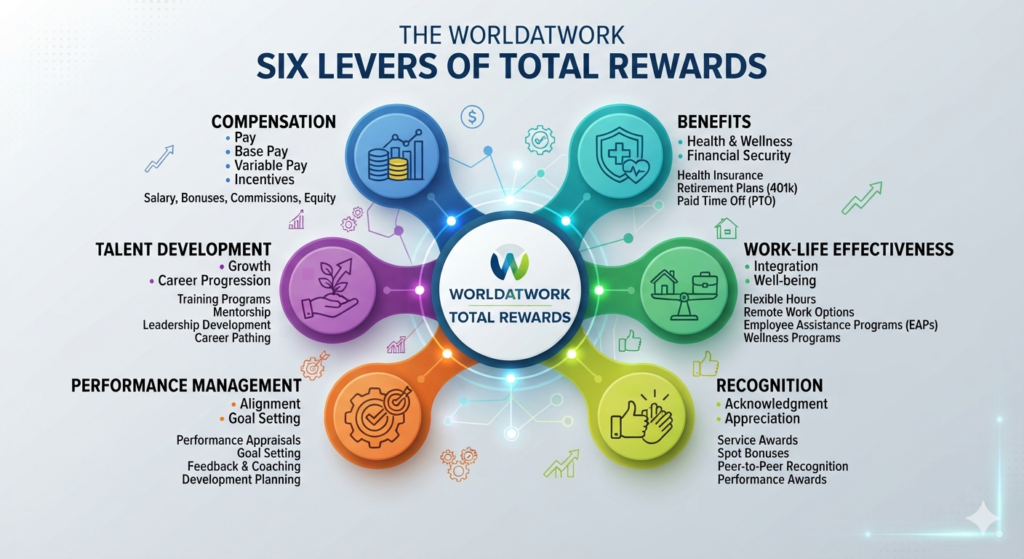
The first lever is compensation: what you pay, including base salary, bonuses, and incentive structures. This is the element owners are most focused on, and for good reason. It is the most direct signal of how the business values contribution. Owners who invest in structure here, market-informed ranges, clear incentive design, and pay tied to the outcomes that matter most, build a foundation that supports both retention and transferability.
The second lever is benefits. Health insurance, retirement plans, leave policies, and employer-funded contributions all shape whether employees feel protected and invested in over the long term. Small businesses have more options than they often realize: defined contribution designs, HRAs, ICHRAs, and association health plans. The strongest packages are not the most expensive ones. They are the ones built around what the workforce actually values most.
The third lever is well-being: the broader support of people’s physical, mental, and financial health. This goes beyond a wellness program or an employee assistance line. It shows up in the culture the owner models, the sustainability of workload expectations, and the degree to which the business treats people as whole people. A business where people are sustainably supported performs better and signals stability to buyers. That is a competitive asset worth building deliberately.
The fourth lever is work-life flexibility. Small businesses often have a genuine advantage here that goes underused: faster decisions, fewer layers, more trust-based arrangements. Flexibility in schedule, location, or role design can be a meaningful differentiator, particularly when competing for talent with employers who offer scale but not agility. It is also a succession consideration: a business designed to operate with flexibility built in is simply more transferable.
The fifth lever is career growth and development: growth, development, and advancement opportunities. Ambitious employees ask one question repeatedly, usually without saying it out loud: is there a future for me here? When the answer is visible, people stay and grow with the business. That growth does not require formal promotions. It comes through stretch assignments, mentorship, cross-training, certifications, and visible investment in the capabilities of the team. For owners thinking about succession, this lever is also how you build the internal depth that makes leadership transition possible. The successor you need may already be in your building.
The sixth lever is recognition: consistent, genuine acknowledgment that someone’s contribution matters. Recognition can be formal or informal, but it has to be specific, timely, and real. A direct, personal thank-you from the owner carries significant weight in a small business environment. During periods of change or transition, recognition becomes even more important because people are watching whether leadership still sees them when attention is pulled elsewhere.
The Real Value of the Framework
The six-lever framework is not just descriptive. Its value is diagnostic. It gives owners a practical way to see what is being managed with intention and where the business is relying on default, and default is not a strategy.
In that sense, total rewards is an owner’s framework. It helps answer the questions that are central to building a durable, valuable business.
Most businesses are doing some of this well. Working through all six levers honestly, with a specific person in mind, reveals which elements are already strong and where the highest-value opportunities are. That is a more useful exercise than a general compensation review, because it surfaces what actually matters for the people you most need to keep.
It also creates a practical sequence for action. Instead of assuming a full overhaul is required, owners can identify the one or two levers most likely to affect retention for the person who matters most. Build the foundation first. Add layers over time. The businesses most ready to transition are the ones that started building intentional total rewards practices while they still had time.
Businesses that can answer the key questions, why do people stay, where are we strongest, what would a buyer see if they looked closely at how we reward and support our team, are further ahead than they often realize. And every owner who works through this framework has just identified one of the most valuable strategic opportunities available to them.
The opportunity here is bigger than a compensation review. It is about designing a people system that supports continuity, growth, and the kind of business that gives its owner real choices about what comes next.

Robin Clukey, SPHR, of IGNITE BRILLIANCE will facilitate this session. Robin helps business owners protect and grow their most valuable asset: their people. At IGNITE BRILLIANCE, she builds HR infrastructure, strengthens leadership capacity, and guides organizations through transitions, bringing Fortune 100 expertise scaled to the needs of small and growing businesses.